

You are standing in a bustling Tokyo market, the vendor is smiling and explaining the price of a handcrafted fan, but every word sounds like static. Your phone’s translation app is clunky, requires Wi-Fi, and makes the conversation feel like a classroom exercise, not a human connection. This is the exact problem AI translation earbuds were born to solve. AI earbuds for language barriers are no longer a futuristic fantasy; they are a practical travel tool that promises real-time, two-way translation directly in your ear. This guide will cut through the marketing noise, explain exactly how this technology works, and give you a decisive framework for choosing the pair that fits your lifestyle and budget, ensuring your next trip abroad is seamless, not stressful.
What Exactly Are AI Earbuds for Language Barriers and How Do They Work?
Unlike standard Bluetooth earbuds that just play audio from your phone, AI translation earbuds are purpose-built devices that capture speech, process it through a translation engine, and deliver the translated audio back to you—often in under two seconds. They are a complete, portable language solution that bridges the gap between two people speaking different languages in real-time.
The Core Technology: Not Just a Dictionary in Your Ear
These devices use a combination of advanced hardware and sophisticated software. The critical components include high-quality microphones with noise reduction (to hear you clearly in a busy café), advanced audio processing, and a connection to a cloud-based or on-device AI translation engine. This engine is not just swapping words; it is understanding context, slang, and colloquialisms to provide a more natural and accurate translation than traditional phrasebooks.
Two-Way Translation: The Conversation Flow
The “magic” happens in the conversation mode. When you speak, the earbud captures your voice. The corresponding app on your phone processes it, translates it into the target language, and plays the audio through your phone’s speaker for the other person to hear. Simultaneously, when they respond into your phone’s mic, the translation is sent directly to your earbuds, allowing you to hear the meaning instantly. This creates a continuous, hands-free loop of communication.
On-Device vs. Cloud Processing: Which Is Better?
This is a critical distinction. Most high-end models use cloud processing, which requires an internet connection (cellular or Wi-Fi) but offers higher accuracy and a broader range of languages. Some newer, premium models have on-device processing, which works offline and is faster and more private, but usually supports fewer language pairs and may be less nuanced in its translations. Your choice depends on whether you prioritize privacy and offline utility or maximum language coverage and translation accuracy.
Why Do You Need AI Translation Earbuds? The Real World Benefits
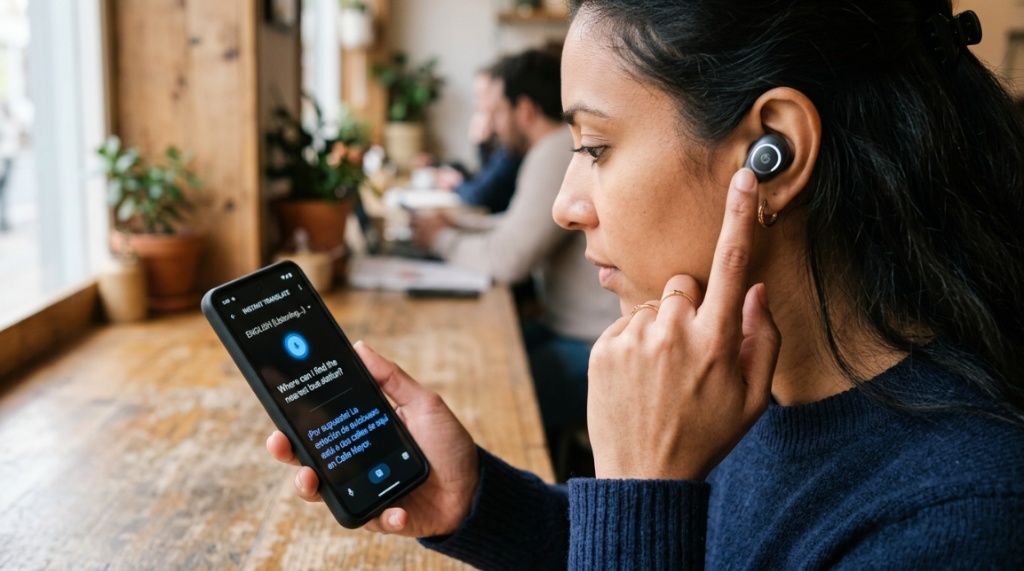
The primary benefit is overcoming communication barriers effectively, but the value goes far beyond just “understanding.” These devices transform the quality of your interactions, making them smoother, more personal, and less stressful. The impact is most profound in high-stakes or high-emotion situations where nuance is critical.
Beyond Tourist Phrases: Navigating Medical and Business Situations
Imagine reading a medical prescription abroad or discussing a contract with a foreign client. Miscommunication here can be costly or even dangerous. AI earbuds provide a first line of defense, allowing you to clarify terms in real-time. While they are not a substitute for a certified human interpreter in legal or medical settings, they provide a significant increase in capability and confidence for everyday professionals and travelers.
Building Human Connections, Not Just Transactions
Using an app on your phone puts a screen between you and the person you’re talking to. Earbuds free you from that visual barrier. You can maintain eye contact, read body language, and engage in a conversation that feels natural. This fosters a deeper level of trust and empathy, which is essential for making friends, conducting business, or simply having a meaningful chat with a local.
Saving Time and Reducing Travel Stress
Struggling to communicate is exhausting. It often leads to taking wrong trains, ordering food you didn’t intend, and feeling lost. AI earbuds streamline these daily interactions. Your time in a new country becomes more about experiencing the culture and less about figuring out logistics, reducing the overall anxiety of navigating an unfamiliar environment.
Key Features to Look For in Top AI Translation Earbuds
Tech specs can be overwhelming, but breaking them down into key decision-making categories simplifies your choice. A good pair of AI earbuds should excel in the fundamentals of audio quality and battery life, while also offering the smart software features that make translation seamless. Do not be swayed by gimmicky extras; focus on the performance that matters most for translation.
Battery Life and Charging Case: The Practical Necessity
There is nothing worse than a dead earbud in the middle of a conversation. Look for a pair that offers at least 4-5 hours of continuous translation time per charge, with a charging case that provides an additional 20+ hours. Check if the case supports fast charging, which can be a lifesaver when you are out all day. Battery performance is a key indicator of overall product quality.
Microphone Quality and Noise Cancellation
The microphones are more important than the speakers in translation earbuds. They need to isolate your voice from background noise—like traffic, wind, or cafe chatter—and transmit it clearly to the translation engine. Look for earbuds with multi-microphone arrays and advanced noise-cancellation algorithms specifically designed for speech enhancement, not just music listening.
Companion App and User Interface
The earbuds are only half the system; the app is the brain. It should be intuitive, allow for easy language selection, and have a responsive interface for conversation modes. A good app will also allow you to tweak translation settings, check battery status, and manage updates. Read reviews specifically about the app’s usability, as a poor app can ruin a great piece of hardware.
How to Use AI Translation Earbuds Effectively in Real Conversations
Simply putting the earbuds in isn’t the whole story. To get the most out of your device and avoid awkward hiccups, there is a practical protocol to follow. Mastering this etiquette sets you up for a smooth conversation, where the technology becomes invisible and the human connection takes center stage.
Before You Travel: The Setup Phase
Always download the companion app and all necessary language packs before you fly. This allows you to use the device in offline mode if you don’t have an international data plan. Practice speaking at a normal pace and volume with a friend to ensure the microphones pick up your voice correctly. This initial preparation ensures you are ready to use the device immediately upon arrival.
During the Conversation: Speaking Clearly and Listening
When you speak, ensure your phone is within the recommended Bluetooth range (usually around 30 feet). Speak in clear, complete sentences, avoiding long, rambling monologues. The AI can translate more accurately when given short, clear inputs. When it’s the other person’s turn to speak, make sure they are speaking clearly and directly into the phone’s microphone for the best results.
The Final Step: Confirming and Clarifying
Even with the best technology, nuances can be lost. If a translation seems off, don’t be afraid to ask “Can you repeat that?” or “Can you try saying it differently?” This shows you are present and interested. This simple feedback loop helps the conversation stay on track and ensures mutual understanding, turning a potential source of frustration into a moment of cooperation.
Which Are the Best AI Translation Earbuds for Different Needs and Budgets?
There is no single “best” pair, but rather the best pair for your specific requirements. Understanding the categories helps narrow down your options significantly. Whether you are a frequent back-packer, a corporate executive, or a digital nomad, there is a device designed for you. Let’s break down the primary market segments.
Price Range and What You Get at Each Level
Budget earbuds (under $150) usually offer decent translation for major languages but may have weaker noise cancellation and shorter battery life. Mid-range options ($150-$300) provide better accuracy, more languages, and improved call quality. Premium earbuds ($300+) often feature the most advanced AI, offline capabilities, and superior audio for both calls and media. Determine your budget early to avoid confusion.
Build Quality and Design: From In-Ear to Over-Ear
Most translation earbuds follow a true-wireless in-ear design, similar to AirPods. However, some are available as over-ear headsets, which can be more comfortable for long conference calls but less portable. Consider your primary use case. If you plan to wear them all day while sightseeing, a lightweight in-ear design is preferable to an over-ear model.
Top Features Comparison: Speed, Accuracy, and Languages
When comparing, look for the number of supported languages and the translation speed. Some devices translate in under 1 second, while others might take 3-4 seconds, which can feel sluggish. Accuracy is often advertised as a percentage, but it can vary depending on the language pair and background noise. Look for real-world tests from independent reviewers, not just manufacturer claims.
| Feature | Importance for Travel | Why It Matters |
|---|---|---|
| Battery Life | High | Critical for all-day use without frequent charging. |
| Noise Cancellation | High | Essential for clear voice pickup in loud environments. |
| Offline Mode | Medium | Useful in areas with poor or no internet connection. |
| Language Coverage | High | Makes sure your target language is supported. |
Can AI Earbuds Replace Learning a New Language Completely?
No. AI earbuds are a highly effective tool for communication, but they are not a substitute for the cognitive and cultural benefits of learning a language. They are a bridge, not a destination. Understanding this distinction manages expectations and encourages a more comprehensive approach to your travels.
The Limitations of Technology: Nuance, Slang, and Emotion
AI struggles with cultural context, sarcasm, jokes, and emotional tone. It can translate the words, but it may miss the intended meaning. A human who has learned the language will pick up on these subtle cues. For deep conversations, relationship building, or understanding cultural subtext, there is no replacement for human learning.
The Digital Divide: When Tech Fails, You Need Skills
Batteries die, connections fail, and microphones break. In these moments, basic language skills are indispensable for asking for help, finding your way, or dealing with an emergency. Owning a phrasebook or having a few essential phrases memorized is a critical backup plan that ensures you are never completely stranded.
A Synergistic Approach: Using Tech as a Catalyst for Learning
The best approach is to use these earbuds as a learning aid. Hear a phrase translated, then repeat it yourself. This is a fantastic way to practice pronunciation and conversational rhythm. The earbuds become a personalized tutor, exposing you to a language in context and giving you the confidence to try speaking it yourself, even if you only know a few dozen phrases. Enhance your travel tech setup by exploring our top picks for Wireless Headphones for Commuting and Travel to ensure maximum comfort on long journeys.
How to Effectively Set Up and Pair Your AI Earbuds
Setting up your new earbuds is generally a straightforward “plug-and-play” process with modern smartphones, but there are some important steps to ensure a flawless experience. A proper setup prevents common issues like poor connectivity and battery drain, allowing you to focus on communication rather than troubleshooting. Let’s walk through it.
Step-by-Step Guide to First-Time Pairing
First, fully charge your earbuds and the case. Next, remove them from the case and put them in your ears. Open your phone’s Bluetooth settings and look for the device name. Select it to pair, just like any other Bluetooth audio device. Then, open the dedicated translator app and follow the on-screen instructions to connect the app to the earbuds, which usually grants the app access to the microphones and the specific translation engine.
Downloading the Necessary Translation Packs
Inside the app, you will typically find a “Language Packs” or “Downloads” section. Before you travel, download all the languages you might need. This enables offline translation and speeds up online translation, as the core processing can happen on your device. Ensure you have enough storage space on your phone for these download packs.
Configuring the App for Everyday Use
Adjust the settings within the app to suit your environment. You can set the default language pairs, the conversation mode (e.g., auto-detect or manual tap-to-talk), and the speed of translation. Test the setup with a friend in a quiet room, then in a noisier environment, to adjust the sensitivity settings. This proactive configuration reduces friction during real conversations.
Comparing Real-Time Translation: Earbuds vs. Phone Apps vs. Dedicated Devices
You might be wondering if you really need dedicated earbuds or if a simple app on your phone will do the trick. While phone apps like Google Translate are incredible tools, they have inherent limitations that dedicated hardware overcomes. Understanding the key differences helps you justify the investment. The answer often lies in convenience, privacy, and audio quality.
Audio Quality and Echo: The Hands-Free Advantage
With a phone app, you are actively holding the phone to your chest or in front of your face, and the other person must lean in to speak to it. This creates audio echoes and is awkward. Earbuds deliver the translated audio privately to your ear, eliminating the phone audio echo and making the exchange feel much more natural, discreet, and professional.
Speed and Efficiency: The Conversational Flow
Swiping through a phone interface to select languages and flip between modes breaks the conversational flow. Dedicated earbuds have a more intuitive interface, often with a simple tap to switch between speaking and listening. This speed is crucial for maintaining a spontaneous and natural dialogue, making the interaction less like a tech demo and more like a real conversation.
Battery and Reliability: The Professional Choice
Relying on your phone app drains your phone’s battery, which is a precious resource when you are traveling or working. Dedicated earbuds have their own battery life, preserving your phone for other tasks. They are purpose-built for continuous translation, meaning they are often more reliable and do not suffer from the performance issues that can arise from running a heavy app on a phone while also using it for navigation and photos.
Tips for Extending the Lifespan and Performance of Your Earbuds
These are precision electronic devices that need a bit of care to function at their best. Simple maintenance routines can significantly extend their lifespan and ensure your translation quality never degrades over time. Whether you are using them daily for work or occasionally for travel, a little care goes a long way.
Cleaning and Maintenance for Optimal Sound
Earwax and dust are enemies of good sound quality. Regularly clean the ear tips and the mesh of the earbuds using a soft, dry, lint-free cloth. Avoid using water or harsh chemicals. For the charging case, keep the contacts clean to ensure proper charging. A simple weekly wipedown can prevent a host of audio and connectivity issues.
Proper Handling and Storage
Always store your earbuds in their charging case when not in use. This not only charges them but protects them from physical damage and extreme temperatures. Avoid dropping them on hard surfaces or leaving them in direct sunlight for extended periods. This simple habit ensures they stay in good working condition for years.
Keeping the Software Updated
Manufacturers regularly release firmware updates that improve translation algorithms, battery optimization, and overall stability. Just like your phone, it’s crucial to keep the earbud firmware up to date. Check the companion app periodically for updates and install them promptly. This ensures you benefit from the latest performance improvements and bug fixes, keeping your device at the cutting edge.
How Many Languages Should Your Ideal AI Earbuds Support?
The number of supported languages is a major selling point, but it is not the only metric you should consider. The *quality* of translation in the languages you actually speak is far more important than having 40 languages that are poorly translated. The most popular languages—Mandarin, Spanish, Japanese, French, German—generally have the highest accuracy. For less common languages, accuracy may drop significantly.
Accuracy in Major Languages vs. Edge Cases
If you are a frequent traveler to Europe or East Asia, you will likely be using the most robust language pairs. However, if you plan to travel to a region where a less common language is spoken, you need to ensure that the specific AI model handles that language pair well. Don’t just assume it works; research independent tests that have reviewed that specific language pair.
The Importance of Regional Dialects
Language is not monolithic. Spanish spoken in Mexico is different from Spanish in Spain or Argentina. Mandarin spoken in Beijing differs from Cantonese in Hong Kong. Advanced AI earbuds allow you to specify dialect or region, which can significantly improve translation accuracy. This is a feature worth looking for if you are traveling to specific regions with a distinct local dialect.
How to Check if Your Language Pair is Supported Well
Before purchasing, go to the manufacturer’s website and check the language list. Look for a section that lists specific dialects. Then, search for YouTube reviews where people test this specific language pair in “real-world” situations. This more targeted research will give you a better idea of performance than trusting the marketing brochure.
Are AI Translation Earbuds for Language Barriers Worth the Investment in 2026?
Absolutely, for the right person, they are a transformative purchase that pays for itself in convenience and opportunities. They are no longer a novelty item; they have become a mature product category. The question isn’t “are they good?” but “are they right for my needs?” The value proposition is highest for those who encounter a language barrier frequently. If you read this and see yourself in the scenarios described, the investment is justified.
Understanding the Cost-Benefit: Travel, Business, or Personal Growth
Consider the cost: a good pair costs as much as a single luxury hotel night or a intercontinental flight fee. Compare that against the value of having a smooth business negotiation, navigating a medical emergency, or making a new friend from a different culture. The return on investment in terms of peace of mind and new experiences is substantial.
When Does It NOT Make Sense to Buy?
If you are a monolingual tourist who only visits places where your primary language is widely spoken, you might not need them. If you are buying them for a one-off trip and will never use them again, renting might be a better option. However, if you plan to travel regularly, even once a year, the utility and convenience they provide make them a smart, long-term travel resource.
Ready to take the plunge? A great starting point for your research is this helpful resource on the AI earbuds for language barriers. It provides a curated look at some of the most popular models available today to help you begin your comparison.
Making the Final Decision: A Checklist for Your Purchase
Before you click “buy,” review this checklist to ensure you’ve covered all your bases. Do the earbuds have the battery life for your typical day? Is the microphone quality good enough for how and where you’ll use them? Have you validated the language pair you need? Does the companion app have good reviews? And finally, is the price within your comfort zone for the value you’ll be getting?
Frequently Asked Questions
Can AI translation earbuds work without Wi-Fi or cellular data?
Yes, some premium models offer offline translation with pre-downloaded language packs. However, the language pair options are more limited and the translation accuracy may be slightly lower than when using cloud-based processing, which requires an internet connection.
How long do the batteries last on a single charge?
Typically, you can expect between 4 to 6 hours of continuous translation time per charge. The charging case provides additional charges, extending the total battery life to around 20-30 hours, depending on the model and usage intensity.
Are these earbuds good for making phone calls?
Yes, they also function as high-quality Bluetooth earbuds for music and phone calls. They often include excellent microphones which are great for clear call quality, even in noisy environments. This makes them a versatile device for all your audio needs.
What is the difference between “listen mode” and “conversation mode”?
Listen mode is for understanding a single person speaking to you, like a tour guide or a lecturer, by translating their speech into your language. Conversation mode is for a two-way dialogue, automatically detecting who is speaking and translating back and forth between your languages.
Are these earbuds a replacement for human interpreters?
No, they are not a substitute for certified human interpreters in critical legal or medical settings. For everyday conversations, travel, and business meetings, they are highly effective and efficient. For high-stakes negotiations or legal proceedings, however, a professional human is still the gold standard.
Can I see the translation text on my phone as well?
Yes, almost all companion apps provide a real-time text transcript of the conversation on the phone screen. This is a helpful feature for clarity, especially if you miss something or need to read a complicated phrase. It serves as a useful visual backup to the audio translation.
Conclusion
Navigating a world of languages is no longer a barrier to connection. Top AI earbuds for language barriers have evolved from a gimmick into an essential travel and business tool, offering a fast, natural, and effective way to communicate. By focusing on battery life, microphone clarity, and the specific language pairs you need, you can select a device that truly serves you. If your work or wanderlust takes you across borders, this technology is a worthwhile investment that removes friction from everyday interactions and opens doors to deeper human connections. Don’t let a language barrier dictate your itinerary; choose your earbuds, pack your bags, and step into a world of unlimited conversation.


Leave a Reply