

The headphones that feel perfect in your living room become completely different products on a packed subway car or during a 5-hour flight — and most buyers don’t discover this until they’re trapped in a noisy environment with headphones that can’t keep up. Affordable wireless headphones for commuting and travel face demands that home listening never reveals: inconsistent noise environments that shift every 30 seconds, quick on/off convenience for announcements and interactions, battery endurance spanning entire travel days, and durability to survive being stuffed in bags alongside laptops and water bottles daily.
Headphones for commuting specifically require strong noise isolation (active or passive), secure fit that survives walking and head movement, quick-charge backup for forgotten overnight charging, and transparent/ambient modes for hearing station announcements without removing headphones. Travel adds requirements for extended battery beyond 20 hours, foldable portability, and comfort sustained across multi-hour sessions.
This guide focuses on what commuters and travelers actually need versus what looks good on a spec sheet — because the $80 headphone with the right commute features outperforms the $300 headphone missing them every single workday.
What Features Matter Most for Daily Commuting Headphones?
Three features define a great commuting headphone: transparency/ambient mode (hear announcements without removal), quick-charge capability (emergency power for forgot-to-charge mornings), and ANC that handles varied noise — not just constant drone but also fluctuating city sounds.
Commuter feature priority ranking:
- Transparency/Ambient mode (essential): Lets environmental sound through without removing headphones. Critical for hearing train announcements, traffic awareness while walking, and quick conversations at ticket windows. Non-negotiable for safety-conscious commuters.
- ANC with adaptive capability (essential): Commute noise changes constantly — quiet platform to loud train to windy outdoor walk. Adaptive ANC adjusts automatically rather than requiring manual mode switching during transitions.
- Quick charge (essential): 5–15 minutes of charging providing 2–3 hours of playback. Covers the “forgot to charge” scenario that happens to everyone 1–2 times monthly. Without this, dead headphones mean an unprotected commute.
- Secure fit during movement (important): Walking, running for trains, and head turns shouldn’t shift headphones or break the ear seal. Over-ear headphones with moderate clamping force stay put better than loose-fitting models.
- Multipoint connection (important): Switch between phone (music during commute) and laptop (calls upon arrival) without manual Bluetooth disconnection/reconnection.
How Much ANC Do You Actually Need for Different Commute Types?
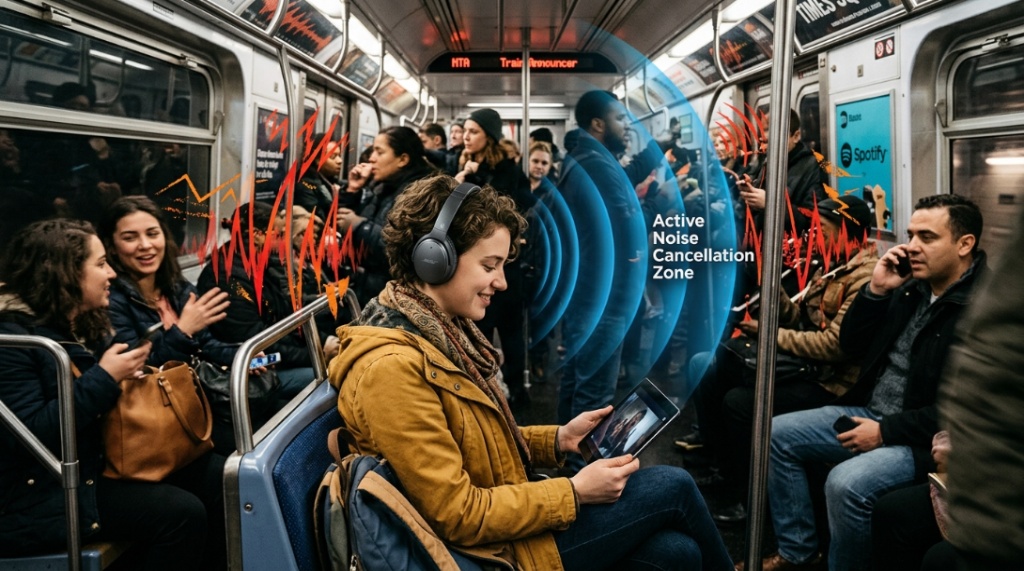
Bus and train commuters need strong low-frequency ANC (engine rumble is the primary irritant). Walking/cycling commuters need moderate ANC with strong ambient mode (environmental awareness is safety-critical). Car commuters need the least ANC — passive isolation often suffices for non-driver passengers.
ANC requirement by commute type:
| Commute Type | Primary Noise Challenge | ANC Level Needed | Budget Recommendation |
|---|---|---|---|
| Subway/Metro | Constant tunnel echo, screeching brakes, crowd noise | Strong ANC + good passive isolation | Over-ear with ANC ($70–$100) |
| Bus/Tram | Engine drone, stop/start vibration, passenger conversations | Moderate-strong ANC | Over-ear or ANC earbuds ($60–$100) |
| Train (above ground) | Track noise, wind at stations, PA announcements | Strong ANC + transparency mode critical | Over-ear with adaptive ANC ($80–$150) |
| Walking/Cycling | Traffic, wind, intermittent loud vehicles | Light ANC with strong ambient mode (safety) | ANC earbuds with awareness modes ($50–$100) |
| Car Passenger | Road/tire noise, engine, AC system | Basic ANC or passive isolation sufficient | Any comfortable wireless option ($40–$80) |
Budget ANC at $70–$100 handles bus and train commuting adequately — reducing engine noise by 50–65%. Premium ANC ($250+) handles the same scenarios at 75–90% reduction. For most commuters, the budget tier provides enough reduction to enjoy music and podcasts comfortably without needing maximum-tier cancellation.
What Makes Travel Headphones Different from Commuting Headphones?
Travel headphones need marathon battery life (20+ hours for long flights), foldable/compact design for carry-on bags, sustained comfort for 4–8 continuous hours, and ANC tuned for airplane cabin frequencies. Commuting headphones can sacrifice some battery and portability for quicker on/off convenience and environmental awareness features.
Travel-specific requirements beyond commuting:
- Battery endurance: A 10-hour flight with 2 hours of airport time demands minimum 12 hours of ANC-on playback for a single travel day. Adding a connection or return flight pushes requirements to 20+ hours. Budget headphones meeting this standard: Soundcore Space One (40hr ANC), Sony WH-CH720N (35hr ANC).
- Comfort for 4+ continuous hours: Airplane seats limit movement — you’re wearing headphones in the same position for hours. Weight under 260g and low clamping force become critical. Lightweight budget pick: Sony WH-CH720N at 192g.
- Foldable design: Carry-on bag space is premium. Foldable headphones reduce to 30–50% of their worn volume. The Soundcore Space One and JBL Tune 770NC both fold flat.
- Wired backup option: Some airlines require wired connection for in-flight entertainment. A 3.5mm cable option (included with most over-ear headphones) lets you plug in without draining battery.
When choosing the right gear, audio health is just as critical as sound quality. Investing in premium active noise-canceling technology allows you to enjoy music at safer, lower volumes rather than blasting audio to drown out roaring jet engines or screeching train tracks. If you routinely struggle to hear your music clearly even with high-quality gear, it might be worth investigating the physiological side of your hearing. Understanding What Happens at a Hearing Test can demystify how your ears process frequencies, helping you better customize the equalizer settings on your new devices for an optimized, safe listening experience.
Which Affordable Wireless Headphones Work Best for Combined Commute and Travel?
The Soundcore Space One ($79), Sony WH-CH720N ($78), and 1MORE SonoFlow ($78) deliver the best combination of commute convenience and travel endurance at budget pricing — all offering 30+ hour battery, competent ANC, foldable designs, and transparency modes.
Top picks for combined commute + travel:
- Soundcore Space One ($79): 40-hour battery (ANC on). Strong ANC for the price. Foldable. LDAC support. Clear transparency mode. Best overall budget travel/commute headphone. Companion app with EQ customization.
- Sony WH-CH720N ($78): 35-hour battery. Lightest at 192g — best for all-day travel comfort. Good ANC. Multipoint for phone + laptop switching. V1 chip for clear calls. Doesn’t fold fully (swivels flat).
- 1MORE SonoFlow ($78): 50-hour battery (ANC on) — longest in the budget tier. Foldable. LDAC support. Good ANC. Weaker microphone than Sony/Soundcore alternatives.
- JBL Tune 770NC ($79): 44-hour battery. Excellent sound with JBL bass signature. Foldable. Decent ANC. Good comfort. Weak point: microphone quality and app limitations.
For earbuds-preferred commuters who also travel, the affordable Nothing headphones and similar budget earbuds offer excellent ANC portability in even smaller packages — ideal for carry-on minimalists who find over-ear headphones bulky.
How Important Is Quick-Charge for Commuters?
Critical — it’s the insurance policy against dead headphones on your commute. A 5–10 minute charge providing 2–3 hours of playback is the feature that separates “usable daily” headphones from ones that occasionally fail you on the worst possible mornings.
Quick-charge comparison for commuter peace of mind:
- Sony WH-CH720N: 60 hours from full charge means you rarely need quick-charge — but 3 hours from 3-minute charge available when needed
- Soundcore Space One: 4 hours from 5-minute charge. Exceptionally fast recovery for forgotten charging nights.
- 1MORE SonoFlow: 5 hours from 5-minute charge. Best quick-charge ratio in the budget tier.
- JBL Tune 770NC: 3 hours from 5-minute charge. Reliable emergency backup.
The real-world scenario: you wake up, grab headphones, they’re at 5%. While you brush teeth and get dressed (8–10 minutes plugged in), they’ve recovered enough for your entire commute. This capability changes a “skip the headphones today” morning into a normal one.
Should Commuters Choose Over-Ear Headphones or Earbuds?
Train and bus commuters benefit more from over-ear headphones (better ANC and passive isolation). Walking and cycling commuters are better served by earbuds (secure fit during movement, better environmental awareness, weather resistance). Choose based on your primary transport method, not general preference.
Transport-based recommendation:
- Train/subway/bus (seated): Over-ear wins. Better ANC, more comfortable for seated duration, larger drivers for superior sound. Movement isn’t a factor when seated.
- Walking commute: Earbuds preferred. Secure in-ear fit during head movement, lighter weight, transparent mode more natural-sounding in earbuds. Over-ear headphones shift during vigorous walking and can look conspicuous.
- Cycling commute: Earbuds with strong ambient mode (safety-critical). Over-ear headphones catch wind and reduce situational awareness dangerously. Many jurisdictions restrict over-ear headphones while cycling.
- Multi-modal (walk → train → walk): Earbuds for flexibility. The constant on/off of over-ear headphones during mode transitions is cumbersome. Earbuds live in your ears throughout transitions seamlessly.
What Portability Features Make Travel With Headphones Easier?
Foldable hinges that reduce headphone volume by 50%+, included hard cases that protect in luggage, lightweight construction under 260g, and a 3.5mm wired option for in-flight entertainment systems collectively define travel-friendly portability.
Portability feature checklist:
- Foldable design: Reduces packed volume significantly. Flat-folding fits into carry-on exterior pockets. Inward-folding reduces footprint in bags.
- Carrying case (included or compatible): Hard-shell protection prevents damage from luggage compression. Some budget headphones include cases; others sell them separately ($10–$20).
- Weight under 260g: Neck-worn during airport transitions, carried in hand through security — every gram counts during travel days.
- 3.5mm cable included: Plug into airplane entertainment systems, use during takeoff/landing when Bluetooth may be restricted on some carriers, and continue listening if battery dies.
- USB-C charging (universal): Same cable as phone and laptop. No extra cables to pack. Fast charging through any USB-C charger you already carry.
How Do You Protect Headphones During Daily Commute and Travel Wear?
Use the included case for bag storage (prevents hinge stress and scratches), clean ear pads weekly to prevent sweat-salt degradation, avoid extreme temperature storage (hot car dashboards, freezing checked luggage), and replace ear pads annually if commuting daily.
Longevity practices for commute headphones:
- Always case when not wearing: Tossing headphones loose in a bag stresses hinges, scratches surfaces, and puts pressure on ear cups. Two seconds to case them adds months of life.
- Wipe after sweaty commutes: Walking segments and summer commutes leave salt residue on pads that degrades materials. Quick wipe with slightly damp cloth prevents buildup.
- Avoid dangling around neck: Wearing headphones around the neck stretches the headband and exposes the underside of ear pads to shirt fabric friction and body oils.
- Replace pads proactively: Don’t wait until pads are cracking. Replace at 12–14 months for daily commuters. Fresh pads restore comfort, seal, and ANC effectiveness simultaneously.
Conclusion
Affordable wireless headphones for commuting and travel need three non-negotiable features: ANC that handles your specific transport noise, quick-charge for emergency mornings, and transparency mode for environmental awareness. Battery life exceeding 30 hours covers both daily commutes and travel days without anxiety. At the $70–$100 budget tier, the Soundcore Space One, Sony WH-CH720N, and 1MORE SonoFlow deliver these essentials without the $250+ premium that flagship models charge for marginally better ANC and slightly lighter builds.
Exploring options across budget tiers? The affordable wireless headphones guide covers models from $49 to $149 with commute-specific testing in real transit environments.
What’s your commute like — duration, transport type, and noise level? Drop details in the comments for targeted headphone recommendations matched to your specific daily journey.
Frequently Asked Questions
Are affordable wireless headphones safe for commuting?
Yes — when using transparency/ambient mode during walking and cycling portions. ANC should only be fully active during seated transit where environmental awareness is less critical. All quality budget headphones include ambient mode specifically for maintaining awareness of traffic, announcements, and emergency sounds during active commuting.
How long should wireless headphone battery last for daily commuting?
Minimum 20 hours with ANC active for comfortable daily use without constant charging anxiety. This provides approximately 2–3 days of typical commuting use (2–3 hours/day) on a single charge. The best budget options offer 35–50 hours, meaning weekly charging is sufficient for most commuters.
Do I need noise cancelling for a short commute?
For commutes under 20 minutes, passive isolation alone (good seal, dense ear pads) may suffice. For 30+ minute commutes, ANC makes a noticeable difference in listening enjoyment and fatigue reduction — even budget ANC. The benefit scales with commute duration: longer commutes gain more from noise cancellation investment.
Can budget wireless headphones handle wind noise during walking?
Most budget ANC headphones struggle with wind — it creates turbulence over ANC microphones that the processing interprets as noise to cancel, causing an unpleasant rumbling sensation. Over-ear headphones with mesh-covered external mics handle wind better than exposed-mic earbuds. Reducing ANC to low/medium during windy walking improves the experience.
Should I buy separate headphones for commuting and travel?
Not necessary at budget pricing. A single over-ear headphone with foldable design, 30+ hour battery, and good ANC handles both daily commuting and occasional travel. Buying two specialized pairs only makes sense if your commute involves vigorous exercise (requiring sport earbuds) while your travel demands premium over-ear comfort.
What happens if my headphones die mid-commute?
Over-ear headphones with 3.5mm cable inputs continue working as passive wired headphones when battery dies — you lose ANC and Bluetooth but retain sound. Earbuds without wired backup become completely non-functional. For commuters worried about this scenario, over-ear headphones with wired backup provide guaranteed uninterrupted audio regardless of charge level.
Are expensive noise-cancelling headphones worth it just for commuting?
For commutes under 45 minutes: budget ANC ($70–$100) provides sufficient noise reduction. For commutes over 1 hour: premium ANC ($250–$400) delivers meaningfully better silence that compounds into significant fatigue reduction over long transit sessions. The longer your daily commute, the more justified premium ANC investment becomes as a quality-of-life purchase.




Leave a Reply